
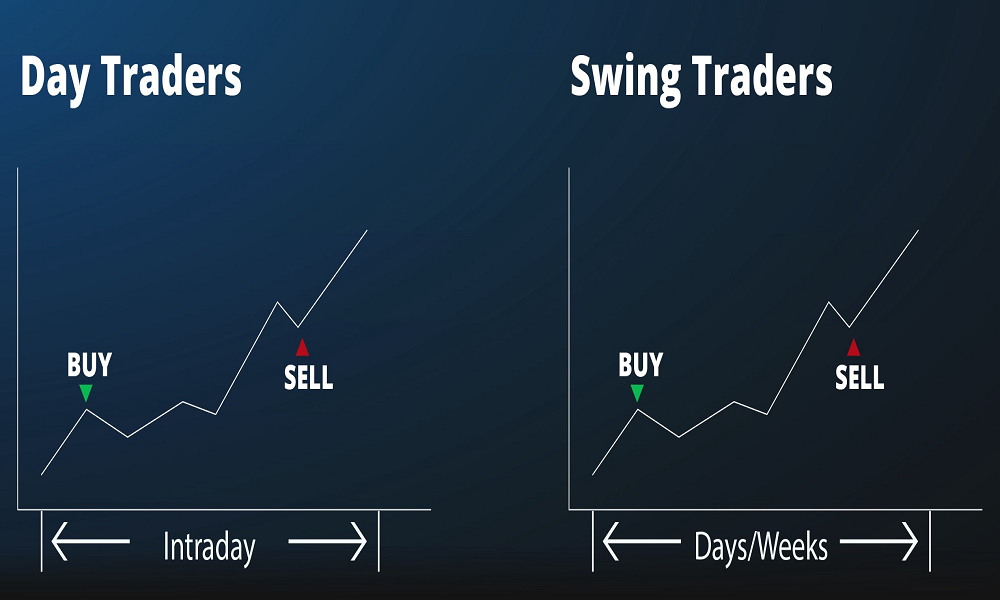
In the trading world, there are various types of traders. But for the active cases, there are two main parties:
1. the day traders and 2. the swing traders.
Both traders are highly seeking to profit in short-term price movements, but they are following individual strategies.
So, in this article, we will reveal the differences between Day Trading vs Swing Trading. So, don't waste time anymore, let's get started-
Day Trading
Day trading means making multiple trades in a single day. Technical analysis is the main key to day traders. Day traders are mostly involved with trading as a job. The U.S. Securities and Exchange Commission (SEC) claims that "day traders typically suffer severe financial losses in their first months of trading, and many never graduate to profit-making status." They make a living by trading stocks, commodities, currencies and make small profits on lots of trades and reduce losses on unprofitable losses.
- Day traders are working alone with their own trading materials. They maintain a flexible schedule and trade with a specific strategy. They are independent of other corporate workers and work at their own pace.
- Day traders take the challenge against high-frequency traders, hedge funds, and those market experts who spend millions to take advantage. There are lots of things like trading platforms, charting software, state-of-the-art computers, and the like that make a heavy cost for a day trader. In different circumstances, their ongoing cost and commission expense can be increased or decreased.
- A day trader must quit his job because they have to pay a lot of attention while trading. Their knowledge and skills are quite usable to magnify the profits for relaxing life and joyful living. Also, if a day trader is going to give his all interest in a single platform, then it will definitely be a successful goal I think.
- Day trading is a spontaneously hard-working job. A trader has to watch all the multiple screens to identify the best points to place a trade and seek the maximum profit they can earn. That's why they need high concentration and interest so that they can focus so long day after day.
- In job circulation, you need higher degrees to attain an interview. But for day trading, you don't need any expensive education. There is no formal education system to educate yourself as a day trader, perhaps you can take a course on technical analysis and computerized trading.
Swing Trading
Swing trading means trading which identity by swings in stocks, commodities, and currencies that take place over a period of time. A swing trader needs a week or a couple of days to make a trade. But swing traders can not make carriers like day traders. Though a trade can select a profession between a day trader or a swing trader.
Being a swing trader is not so hard. Anyone can be a swing trader with some investment capital and knowledge. Because of the long-term conditions, they do not need to sit all day long before the screens. They can continue a full-time job besides trading.
- Trades depend on time. Once you start a trade and open it for some days or weeks may result in higher profits than trading multiple times in a day.
- Swing trading is usually held at least overnight and needs a higher margin. And its maximum leverage is equal to 2x capital. If we compare this with day trading, where margins are equal to 4x capital.
- A swing trader needs to set stop losses. Where extremely volatile market pairs can make unpredictable losses you can't imagine. Compared to the day traders, it needs to put stop-loss at certain potions.
- Swing trading using one computer and some familiar trading tools to work out. It doesn't demand multiple screens and a high-quality setup like day trading.
- In swing trading, there are some huge losses that may occur while trading. Because swing traders are holding trades for several days or weeks, so it takes a higher risk of substantial losses.
- Swing trading does not require full-time work. So, the stress is pretty less in this case. Most swing traders usually have a job or an income source from where they can maintain their daily trading process.
Both trading types have advantages and disadvantages. Swing trading and day trading has a good strategy and both have their own preferences. Where a trader is skillful, dedicated, patient and his hard work rely on which strategy he will work on. But day trading is suitable for those who want to trade during the full day and make sure that it is his only profession.
Day Trading | Swing Trading |
Multiple Trading in a Day | Several trades per week |
Full-Time Trader | Part-Time Trader |
Trades hold hours to days | Trades hold days to weeks |
Use short-term buy-sell strategy | Analyze momentum and trend strategy |
Using multiple screens with advanced trading technology | A Standard account may require |
Multiple, smaller gains or losses | Fewer, but more profits or losses |
The Conclusion
Day trading and swing trading are pretty popular among traders. Both trading types have advantages and disadvantages. But in this article, we see in spite of disadvantages, both trading strategies are the main reason for millions of traders' subsistence. It affects a huge impact on trading careers around the world. But with proper knowledge and accruing the proper facilities are the only reason for profitable trading. That's why you must keep learning.
We wish you a profitable trading career!
Comments
Post a Comment